
Xylem Lab Takes Smallholder Crop Mapping to the World Stage at ISPRS 2026
By: Monica Adjei | July 27, 2026
Xylem Lab was represented at the XXV ISPRS Congress in Toronto this July, where Valinho António, a research scholar at the lab, presented "GLSTM-MLP: A Deep Learning Framework for Crop Type Classification in Smallholder Farms with PlanetScope Images," work co-authored with Dr. Catherine Nakalembe and colleagues. Convened by the International Society for Photogrammetry and Remote Sensing, the Congress brings the global remote sensing community together to reflect on the field's history and shape its future.
Valinho presented on the afternoon of July 9, drawing a steady stream of questions across the two-hour session. His study addresses a persistent challenge in agricultural monitoring: distinguishing crops in the small, fragmented, often intercropped fields typical of Rwandan smallholder systems. Using 3m PlanetScope imagery and drone-based ground truth from two Rwandan villages, the team's hybrid GLSTM-MLP framework pairs Haralick texture features with sequential modeling to capture both spatial context and temporal rhythm, reaching F1-scores as high as 93% and outperforming conventional machine learning models in this data-scarce setting. The approach generated real interest, with many attendees curious about how Haralick features work and how they were integrated with the LSTM-MLP model.
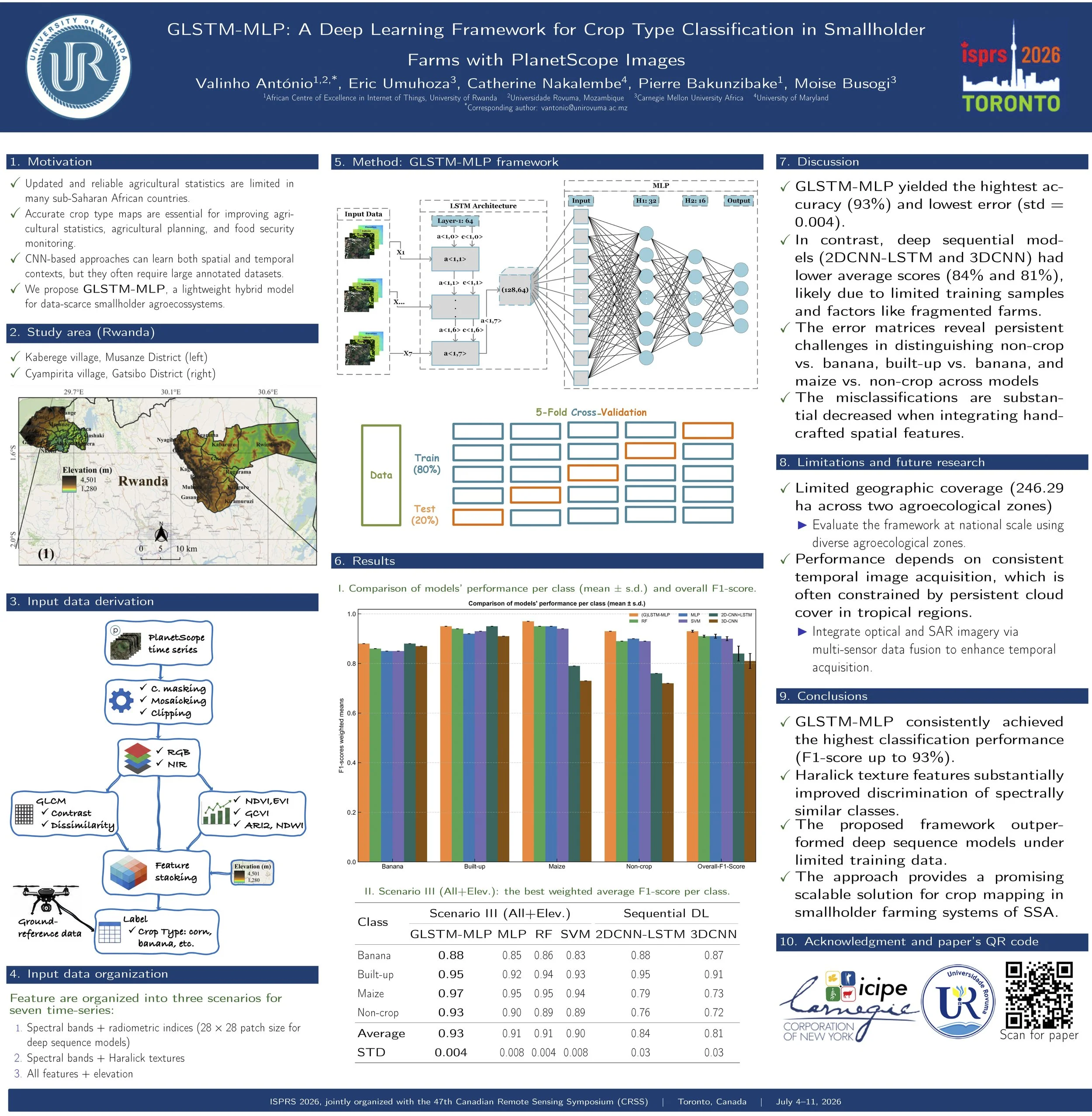
Poster: GLSTM-MLP: A Deep Learning Framework for Crop Type Classification in Smallholder Farms with PlanetScope Images, presented at the XXV ISPRS Congress, Toronto.
Among those who stopped by was Mr. Cung Thang of the UN Geospatial division, who encouraged looking beyond crops alone and trying to separate non-crop cover, such as trees and shrubs, to extend the approach to forest monitoring and climate-change applications. Valinho also connected with Dr. Tobias Landman of ICIPE-Kenya, Science Lead at Digital Earth Africa, and the two discussed leveraging Digital Earth Africa's data cubes in future studies to test whether the models can be further developed for crop-type discrimination across Sub-Saharan Africa.
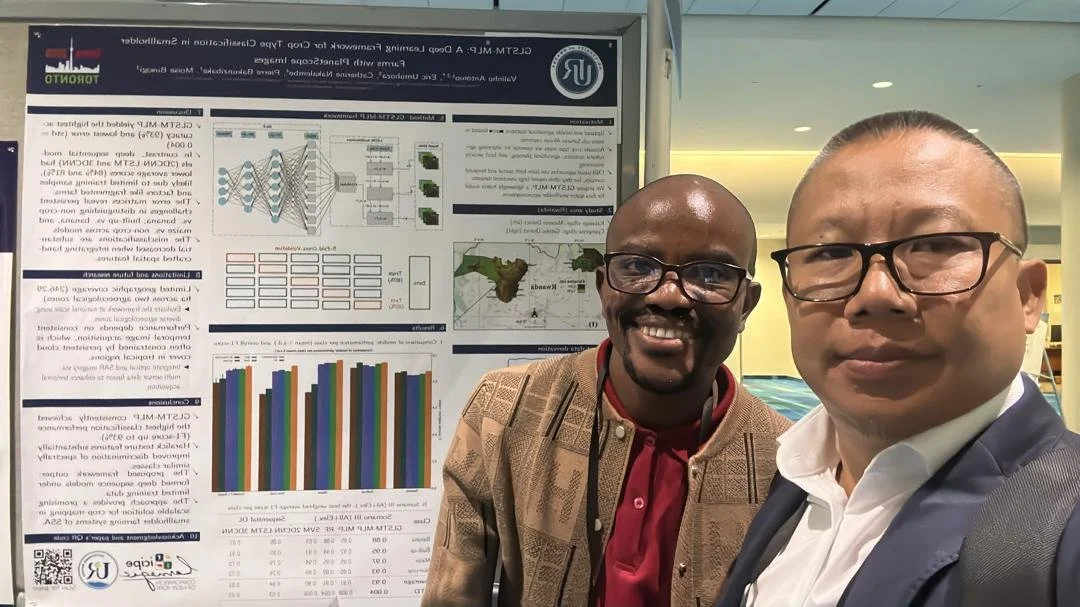
Xylem Lab Research Scholar, Valinho António, with Mr. Cung of the UN Geospatial Division at the poster presentation.
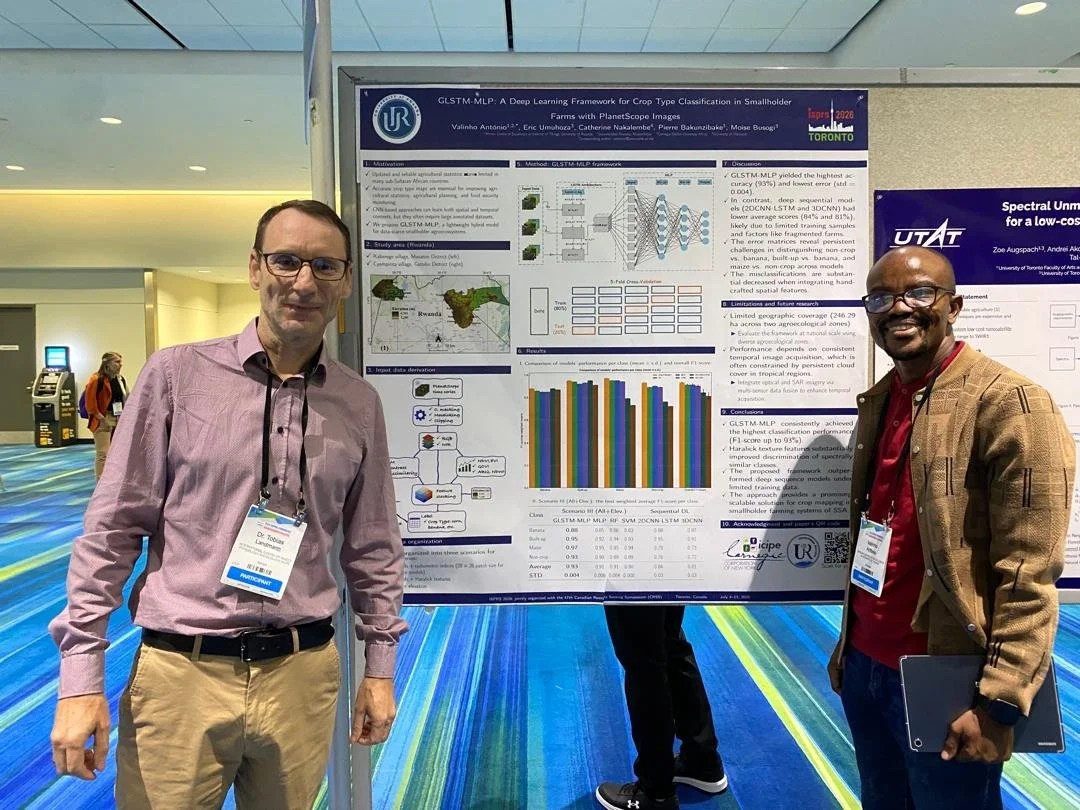
Research Scholar, Valinho António, with Dr. Tobias Landman (ICIPE-Kenya), Science Lead at Digital Earth Africa.
Valinho came away with plenty to build on. A "Geospatial Deep Learning in Practice" tutorial led by Natural Resources Canada's Mozhdeh Shahbazi and Victor Alhassan reinforced a core lesson: that data quality and careful exploratory analysis often matter more than model complexity. He noted the exciting possibilities that EnMAP and geospatial foundation models such as TESSERA and AlphaEarth have to offer for crop-type classification, while flagging that applying them to smallholder farms with cross-year growing seasons calls for careful consideration. He then observed how high-resolution imagery remains underused for crop-type discrimination, likely due to data-access constraints and the relatively few studies focused on smallholder systems.
Above all, conversations with researchers working on similar problems renewed his motivation to keep exploring GeoAI for agricultural monitoring; a reminder that scientific progress is driven by collaboration, mentorship, and a shared commitment to global challenges like climate change and food security.
Beyond presenting, Valinho served as a Congress volunteer, joining fellow volunteers for a dinner on July 10, the evening before ISPRS 2026 drew to a close.
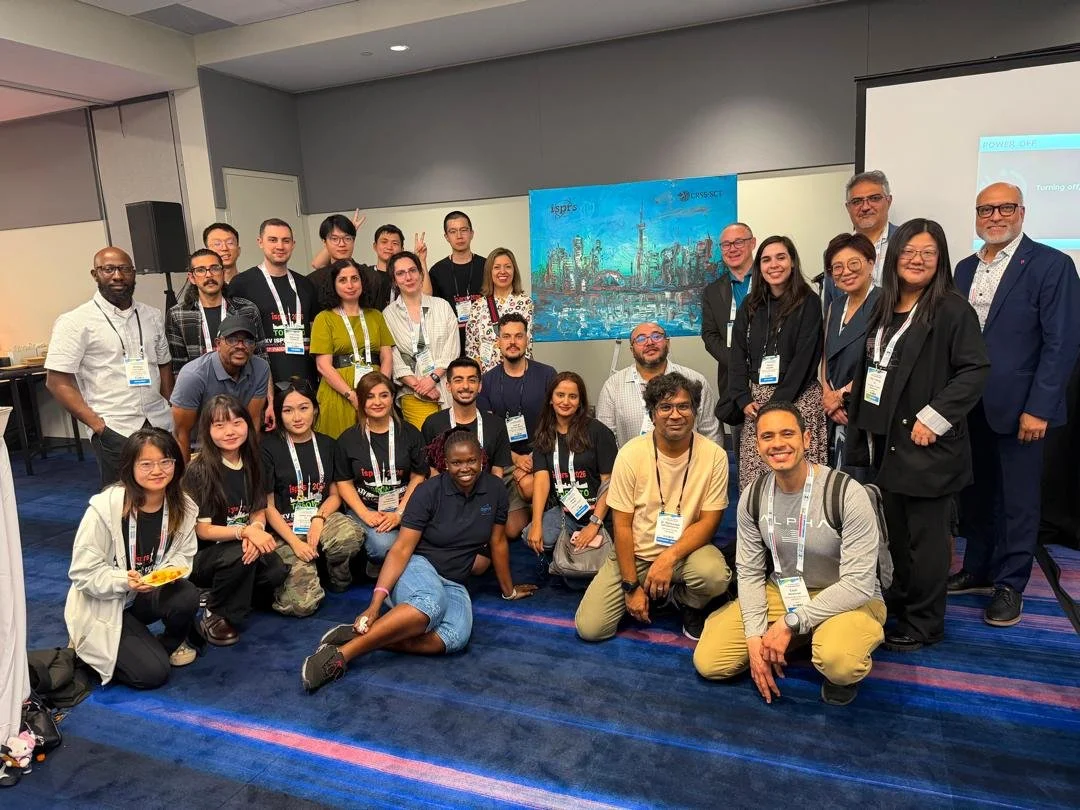
Congress volunteers gather for dinner on July 10, the evening before ISPRS 2026 closed.
Read the manuscript here:António, Valinho, and Umuhoza, Eric and Nakalembe, Catherine and Bakunzibake, Pierre and Busogi, Moise, GLSTM-MLP: a deep learning framework for crop type classification in smallholder farms with PlanetScope images (November 10, 2025 - SSRN).
